The $20,000 Question
Picture this agent performance tracking scenario:
A plumber in Austin spends $20,000 a month on Google Ads, receiving non-stop calls around the clock. Two agents answer the calls; Brandon and David. Whoever is available picks up. They are a small team with a simple setup and a big budget. On paper, everything looks great. They have a constant stream of interested callers ringing them, their ad campaigns are generating volume, and yet…
When the plumber was asked “Which agent is making you money?“, he didn’t know how to respond.
He knew how much he was spending and how many calls he was receiving, but the things he didn’t know were far more important. He didn’t know how many calls Brandon handled versus David. He didn’t know who booked more appointments. He didn’t know who converted better. He didn’t know what percentage of revenue each agent brought in.
Despite this, the plumber was still investing $20,000 every month without a clear agent performance call tracking system in place – and he’s not alone.
The visibility gap that most businesses overlook
This is where most businesses get stuck. They track marketing metrics obsessively. They know their cost per click, their cost per call, and which campaigns generate the most volume, but they rarely track what happens after a call. The conversation itself – the quality of the interaction, the outcome, and the revenue attached to it – often remains unstructured and unmeasured.
The data is there. What lacks is structure.
Without structured conversation data, performance conversations become subjective. If one agent converts more effectively than another, that difference quietly impacts profitability. But without visibility, it’s impossible to diagnose, let alone fix.
How Custom Fields extract the most useful data from conversations
In this case, the solution was implemented directly inside Nimbata.
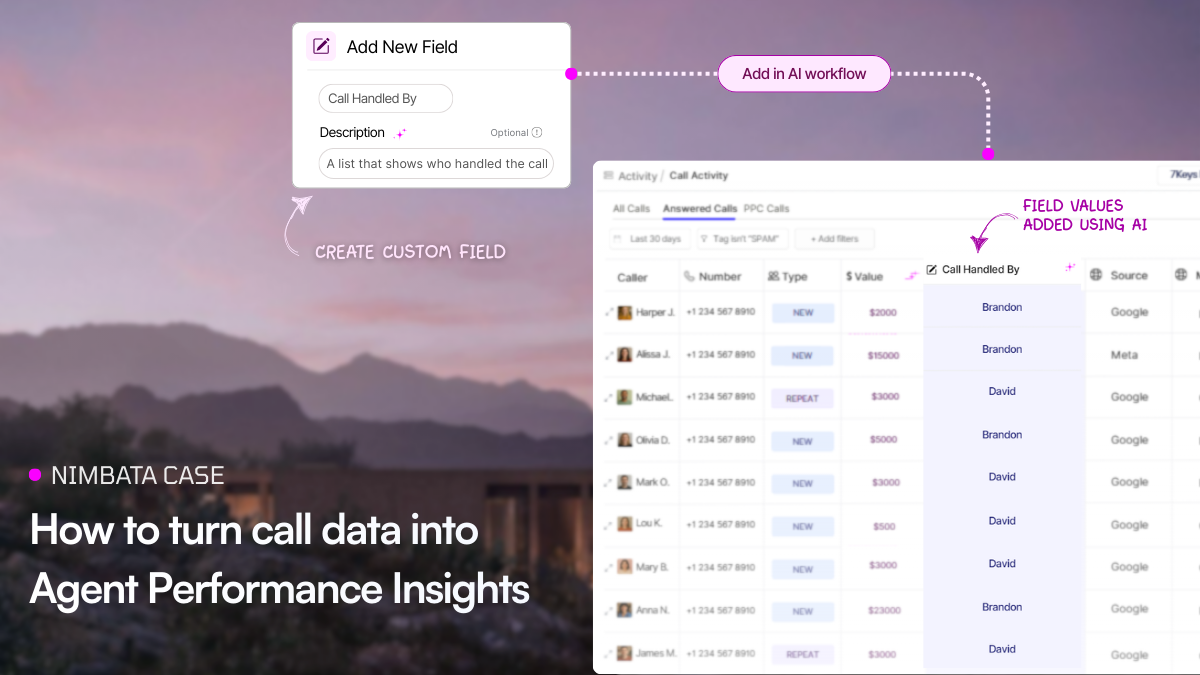
The plumber created a dropdown Custom Field called ‘Call Handled By’ with two options: Brandon and David.
Inside a Nimbata AI workflow triggered when the call ends, he added a simple instruction. If the greeting says “Hi, this is Brandon,” select Brandon. If it says “Hi, this is David,” select David.
From that point forward, every call was automatically assigned to the correct agent.
Nimbata’s AI detected the greeting and populated the Custom Field without manual input. The field became part of the call record and could be used in reports, filters, dashboards, and CRM integrations.
A minor setup adjustment created clear performance visibility.
Agent performance tracking: Moving from assumption to proof
Once the data was structured, the plumber could see how many calls each agent handled and compare booking rates within his Nimbata reports.
He also used AI call scoring to review script adherence, objection handling, and missed opportunities. Instead of relying on perception, he could examine performance metrics tied to real calls.
More importantly, he could connect agent activity directly to revenue.
By combining the “Call Handled By” Custom Field with appointment tracking and cost per call data, he calculated:
- Revenue per agent
- Cost per booked appointment per agent
- ROI contribution by individual agent
The $20,000 monthly ad spend was no longer measured only by call volume. It was measured by revenue contribution at the agent level.
That level of clarity changes how decisions are made.
Campaign data alone does not suffice
Most businesses optimize campaigns. Few analyze conversations with the same attention.
If performance varies between agents, return on ad spend depends partly on who answers the phone. Without structured call data, that factor remains hidden.
Connecting the full chain matters:
Campaign > Call > Agent > Outcome > Revenue
When that connection is visible, marketing and operations stop functioning in isolation. Performance gaps become measurable instead of speculative.
Custom Fields: How to go beyond Agent Tracking
Agent tracking is one example of how Nimbata Custom Fields can be used.
The same structure can capture other insights from conversations.
- A Custom Number Field can score lead quality based on urgency and budget signals.
- A Yes or No field can flag emergency calls when certain language is used.
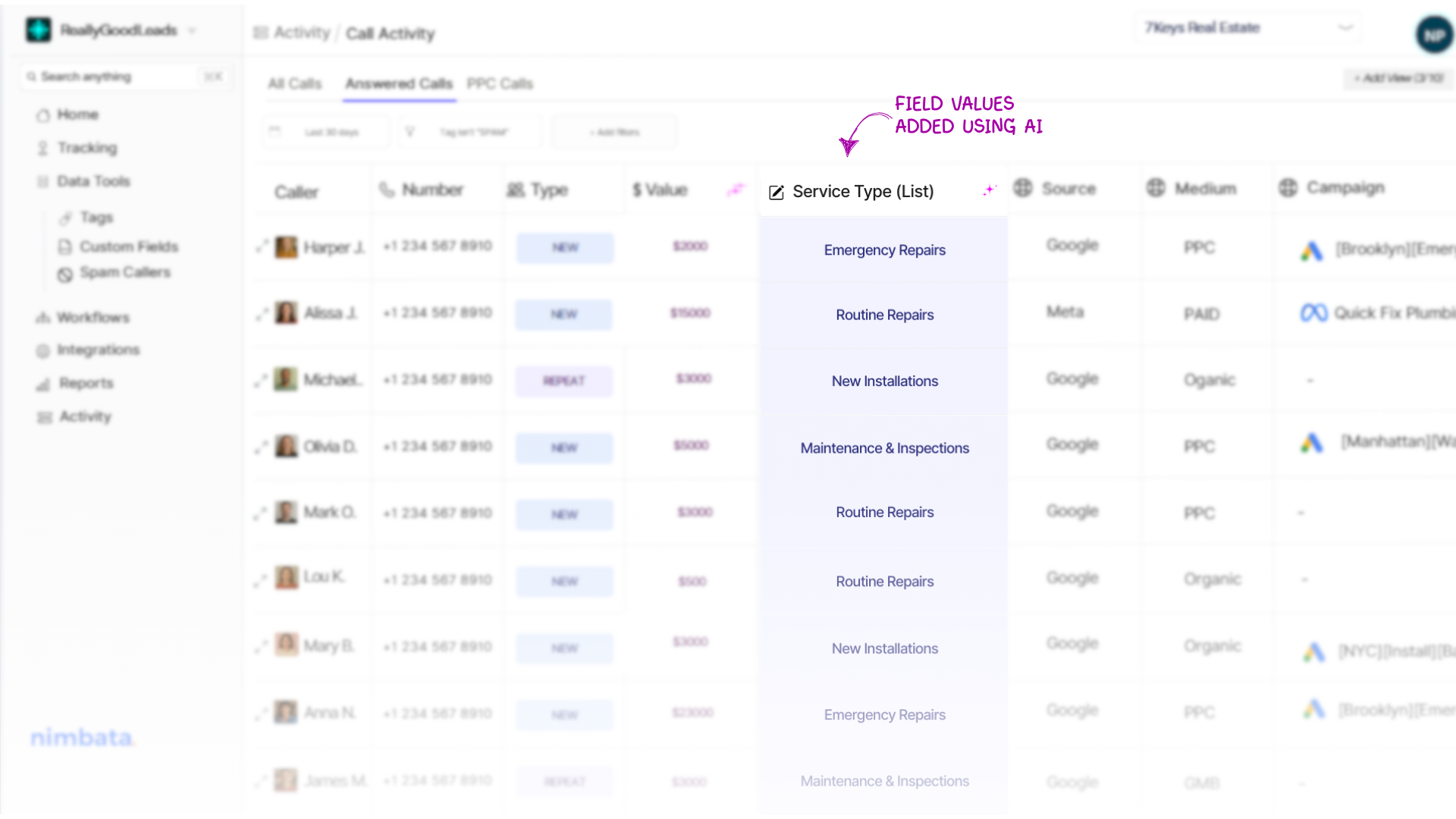
- A List field can categorize service type to reveal which offerings generate the most revenue.
- A Boolean field can identify missed opportunities when a caller shows intent but no appointment is booked.
In each case, Nimbata’s AI listens to the call and fills the Custom Field automatically. Conversations become structured records that can be filtered, reported on, and analyzed.
Learn more about Nimbata: Call Tracking | Custom Fields | Call Tracking Reports | Solutions by Industry | Help Center Documentation on Custom Fields
The positive trickle-down effect of Custom Fields
The objective is not to collect more information. It is to make the information inside conversations usable.
Once calls are structured using Custom Fields, reporting becomes more accurate. Coaching becomes more targeted. Budget allocation becomes grounded in measurable outcomes.
For businesses investing heavily in paid acquisition, this level of visibility supports smarter decisions.
When you spend $20,000 a month to generate calls, you should know exactly who is converting those calls into revenue.
Further reading
- Learn industry methods for monitoring agent performance
- Explore widely used call quality and agent performance metrics
- Understand the importance of first call resolution in performance measurement
Frequently Asked Questions about agent performance tracking
What is agent performance tracking?
Agent performance tracking is the process of measuring how individual team members handle inbound calls and how those conversations contribute to revenue. It goes beyond tracking call volume and focuses on outcomes such as booking rate, revenue per agent, and missed opportunities.
When structured correctly, agent performance tracking connects marketing spend to measurable results at the individual level.
How can you measure agent performance from phone calls?
To measure agent performance, you need structured call data. This includes identifying which agent handled the call, whether an appointment was booked, and how much revenue was generated.
With AI call analysis, platforms like Nimbata can automatically extract this information from conversations and assign it to Custom Fields. Once structured, you can compare booking rates, calculate revenue per agent, and identify performance gaps.
How do you track revenue from phone calls?
To track revenue from phone calls, you must connect call attribution data with appointment tracking and sales outcomes.
This means knowing which campaign generated the call, which agent handled it, and whether it converted into revenue. When these data points are structured inside your call tracking system, you can calculate revenue per call and revenue per agent.
What is call attribution by agent?
Call attribution by agent refers to identifying which team member handled each inbound call and linking that activity to measurable outcomes.
Instead of evaluating campaigns only by call volume, call attribution by agent allows businesses to analyze conversion rates and revenue contribution at the individual level. This creates accountability and highlights coaching opportunities.
How does AI improve agent performance tracking?
AI improves agent performance tracking by automatically analyzing conversations and extracting key information such as service type, urgency, booking confirmation, and agent identity.
This removes manual tagging and ensures consistency across all calls. With AI call analysis, performance data becomes reliable and scalable.
Why is revenue per agent an important metric?
Revenue per agent helps businesses understand how individual performance affects overall profitability.
If two agents handle the same number of calls but generate different levels of revenue, that difference directly impacts return on ad spend. Tracking revenue per agent supports better coaching, staffing decisions, and budget allocation.
Can small businesses benefit from agent performance tracking?
Yes, they can. Even businesses with small teams benefit from structured agent performance tracking.
When marketing budgets increase, visibility becomes more important. Knowing which conversations generate revenue allows businesses to improve performance without increasing ad spend.