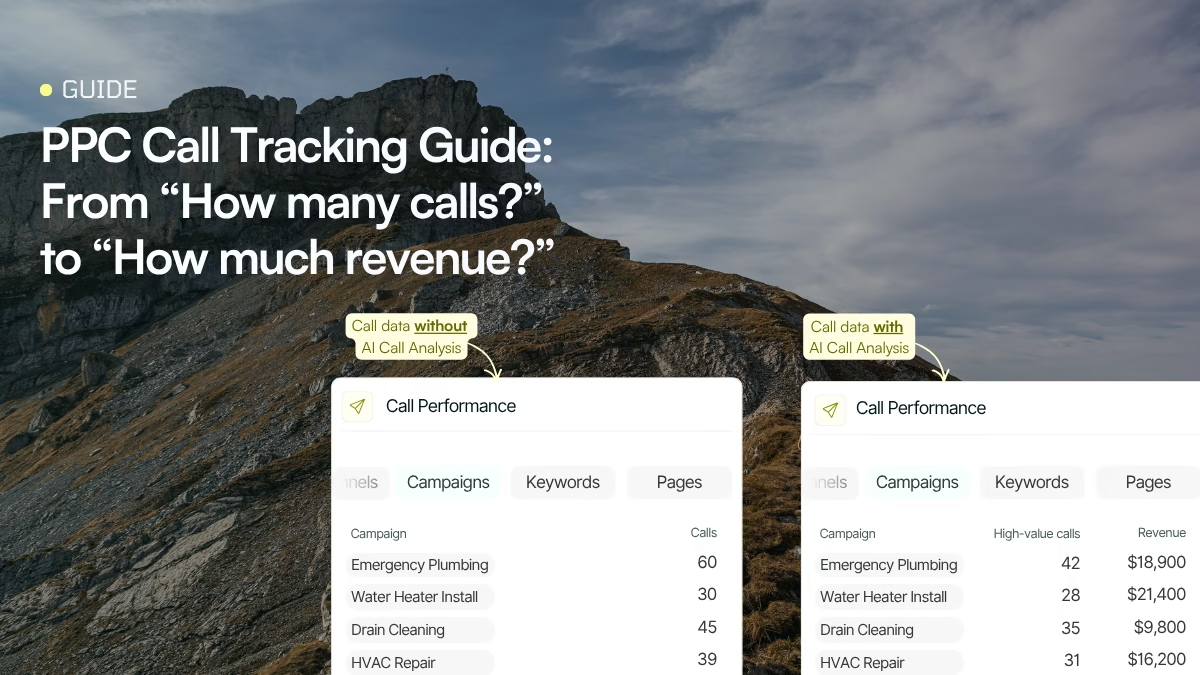
If phone calls are an important part of your PPC strategy, knowing how many calls your ads generated is only the beginning.
The real question is: which paid campaigns generated calls that were actually worth something?
A keyword can generate dozens of calls and still perform worse than a keyword that generates only a handful. Some callers are ready to buy. Others are existing customers, spam calls, wrong numbers, or people looking for a service you don’t offer.
In 2026, PPC call tracking is moving beyond simply counting calls. The goal is to connect paid traffic, phone conversations, lead quality, and revenue in one measurement loop:
Ad → Click → Website → Call → Qualified lead → Customer → Revenue
That data can then be used not only to report on PPC performance, but to make better budget and bidding decisions.
What is PPC call tracking in 2026?
PPC call tracking connects phone calls to the paid advertising interactions that generated them.
At its simplest, that means answering:
Which paid campaign generated this call?
But modern PPC measurement needs to go further.
A useful PPC call tracking setup should help you understand:
- Which campaign generated the call
- Which ad group and keyword drove it
- Which landing page the visitor came from
- Whether the call was answered
- What the caller wanted
- Whether the caller was a good lead
- Whether an appointment was booked
- Whether the call resulted in a sale
- How much the opportunity or sale was worth
This changes the way PPC performance is measured.
Instead of looking at:
Clicks → Calls
you can look at:
Clicks → Calls → Qualified leads → Sales → Revenue
That distinction matters because a call is an action, not a business outcome.
Google Ads has native tools for measuring phone activity, but they are designed around Google’s advertising ecosystem. If you want to understand the call itself and connect it to outcomes further down the funnel, you need a call tracking system that can capture and enrich that data.
Looking specifically for Google’s native solution? See our guide to Google Ads call tracking.
How do you attribute calls to PPC campaigns?
The first job of PPC call tracking is attribution.
When someone clicks a paid ad and later calls your business, you want to connect that phone call to the original advertising interaction.
The journey might look like this:
Google Ads → Landing page → Phone call
Or:
Microsoft Ads → Landing page → Phone call
Without call attribution, the ad platform may know that someone clicked. Your phone system knows that someone called. Your CRM might know that someone became a customer.
But those three pieces of data can remain disconnected.
Connect the click to the call
For website calls, call tracking software can use information captured when the visitor arrives on your site, such as the Google Click ID (GCLID), campaign parameters, and session information.
Nimbata’s Dynamic Number Insertion (DNI) uses the paid visitor’s session information to associate the eventual call with the advertising source. Its current setup captures the GCLID and can pass campaign, ad group, keyword, and landing-page information with the call.
The result is a call record that can look more like:
- Campaign: Emergency Plumbing
- Ad group: Emergency Plumber
- Keyword: emergency plumber near me
- Landing page: /emergency-plumbing
- Call: 3:42
- Outcome: Qualified lead
- GCLID: XXXXX
Now the call becomes useful PPC data.
Use both auto-tagging and UTMs
For Google Ads, make sure auto-tagging is enabled so Google can append the GCLID to ad click URLs.
You can also use UTM parameters when you need additional control over how paid traffic is labeled in your call tracking and analytics reports. Using both gives you Google’s click identifier plus your own campaign labeling.
What happens when attribution gets lost?
This is one of the harder problems for PPC teams today.
Browser restrictions, ad blockers, consent settings, redirects, and tracking configuration issues can cause client-side attribution signals to disappear.
If the GCLID is missing, for example, Nimbata cannot match a call back to the corresponding Google Ads click.
This is where server-side tracking becomes useful.
With a server-side setup, call events can be sent through a server-side Google Tag Manager container rather than relying entirely on browser-side tracking. Nimbata supports server-side tracking through sGTM, which can help bypass browser and ad-blocking restrictions that might otherwise interfere with client-side event delivery.
For PPC specialists, this matters because better attribution means more reliable optimization data
How do you know which keywords and ad groups generate good calls?
This is where PPC call tracking becomes much more useful than simply measuring call volume.
Imagine you have two keywords:
| Keyword | Calls | Qualified calls |
|---|---|---|
| emergency plumber | 50 | 8 |
| emergency plumber near me | 25 | 15 |
If you’re optimizing for call volume, the first keyword wins. If you’re optimizing for qualified leads, the second keyword is clearly more interesting.
Measure quality at the keyword level
Your reporting should allow you to move from:
Keyword → Calls
to:
Keyword → Calls → Quality → Revenue
Useful metrics include:
- Total calls
- Answered calls
- Qualified calls
- Qualified call rate
- Cost per qualified call
- Appointments
- Sales
- Revenue
- Return on ad spend
This lets you identify the paid traffic that creates actual opportunities instead of simply generating activity.
Use call outcomes as PPC data
You can classify calls using rules based on information already available in the call record.
For example:
Call duration > 60 seconds → Qualified Call
Or:
Call tag = Booked Appointment → Appointment
This is useful when your qualification criteria are straightforward and predictable.
Use AI when quality depends on the conversation
Some questions cannot be answered from call metadata.
For example:
Was this call a good lead?
You cannot reliably answer that from duration alone.
The conversation might reveal that the caller:
- Has the right service need
- Has the right budget
- Is ready to buy
- Is looking for a competitor
- Is an existing customer
- Called by mistake
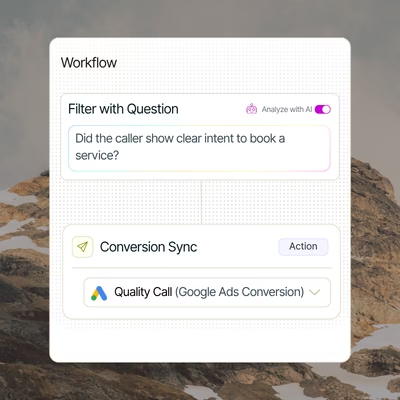
Nimbata AI can analyze conversations and turn these types of questions into structured call data. You can use your own prompts to classify intent, lead quality, outcomes, and other information contained in the conversation.
That gives PPC teams another useful workflow:
Call → AI Question → “Good lead?” → Yes → Qualified Lead
How do you connect calls across paid channels?
PPC rarely means Google Ads alone.
Depending on the business, you might be running:
- Google Ads
- Microsoft Ads
- Meta Ads
- OpenAI Ads
- Other paid campaigns
If each platform has its own reporting, it becomes difficult to answer a simple question:
Which paid channel is generating the best phone leads?
A call tracking platform can bring those calls into one reporting layer.
For example:
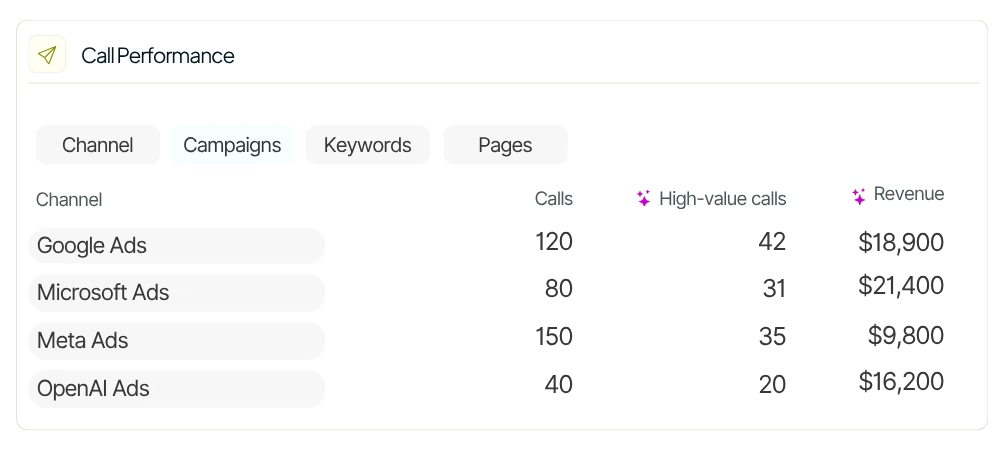
Suddenly, the channel with the most calls is not the channel with the most revenue.
You can make the same comparison at the campaign, ad group, keyword, landing page, or location level.
This is particularly valuable for agencies because it creates a consistent way to evaluate paid media across clients and platforms.
Nimbata supports sending different call conversion types to platforms including Google Ads, Meta, and Microsoft Ads, using different triggers for each conversion.
How do you track PPC calls and optimize based on call quality instead of volume?
The biggest mistake in call-heavy PPC campaigns is treating every call as equally valuable.
They’re not.
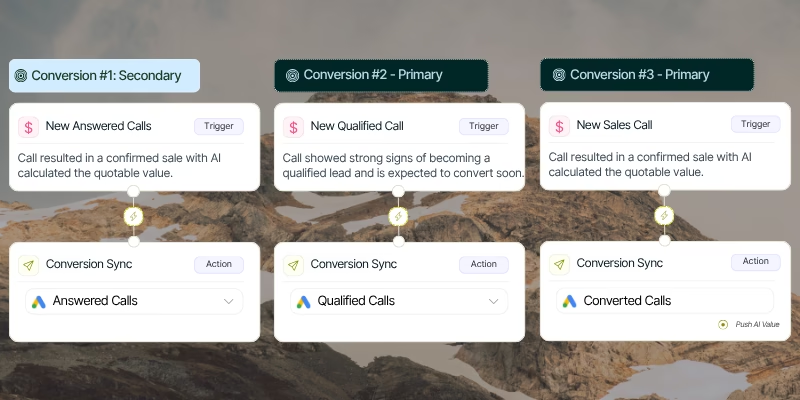
A 15-second wrong number and a 15-minute conversation with someone ready to buy are both “calls.” They should not necessarily receive the same weight in your PPC reporting or optimization.
Start with a clear definition of a valuable call
For example:
All calls
↓
Answered calls
↓
Qualified calls
↓
Appointments
↓
Sales
You can decide which stages matter for your business.
Then turn those outcomes into conversion signals
Suppose you want Google Ads to optimize toward qualified leads.
Your workflow could be:
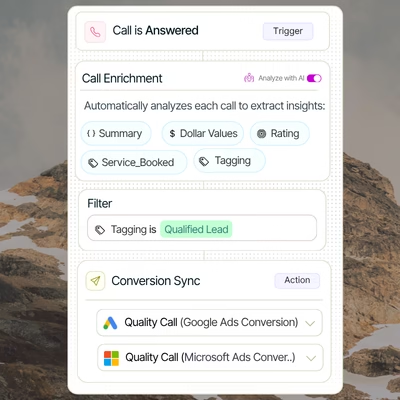
Call received
→ Nimbata analyzes the call
→ AI determines whether it was a qualified lead
→ Qualified = Yes
→ Send Qualified Lead conversion to Google Ads
Now Google Ads receives a much more meaningful signal than simply “someone called.”
Nimbata lets you create multiple conversion types and use different triggers for each one. Calls that don’t meet any of your defined conversion conditions are not sent as conversions.
Don’t throw away call data that isn’t a conversion
A call can be valuable for reporting even if it isn’t sent to Google Ads as a conversion.
For example, you might want to report on:
All calls: 500
Answered: 430
Qualified: 180
Appointments: 74
Sales: 31
Your advertising platform can receive the signals you want it to optimize against, while your call tracking platform retains the broader picture.
That separation gives PPC specialists more control over both reporting and optimization.
How do you send qualified calls back to ad platforms?
Once you know what a valuable call looks like, you can send that information back to the advertising platform.
The workflow is:
Call → Qualification → Conversion → Ad platform
There are two common ways to determine whether a call qualifies.
Use automation rules
You can use rules based on call properties such as:
- Duration
- Call status
- Tags
- Call outcomes
- Tracking number
- Custom fields
For example:
If call duration is longer than 60 seconds, send a Qualified Call conversion.
Or:
If call tag = Appointment Booked, send an Appointment conversion.
Use AI questions
When you need to understand what happened during the conversation, use AI. For example:
Was this call a good lead?
If the answer is Yes, your workflow can fire a Qualified Lead conversion.
You can create similar questions for:
- Lead quality
- Buying intent
- Appointment status
- Service requested
- Sales outcome
- Customer type
- Estimated opportunity value
This lets you build conversion logic around the actual conversation, rather than relying only on call metadata.
Create conversions directly from Nimbata
You don’t necessarily need to create every conversion action manually in Google Ads first.
Nimbata’s current Google Ads integration allows you to create a conversion directly from the Nimbata interface, select the relevant Ads account, and then connect that conversion to a workflow.
For more advanced setups, you can create multiple conversion actions and map each one to a different trigger.
For example:
Qualified Lead → Qualified Lead
Appointment → Appointment Booked
Sale → Sale Confirmed
This gives your PPC strategy a much richer conversion structure.
How do you calculate PPC ROI and ROAS from phone leads?
If you generate leads by phone, measuring clicks and calls alone doesn’t tell you your actual PPC return.
You need to connect the phone lead to a value.
The basic calculation is:
PPC ROAS = Revenue generated from PPC ÷ PPC ad spend
For example:
You spend $10,000 on PPC. Those campaigns generate phone leads worth $35,000 in revenue.
Your PPC ROAS is:
$35,000 ÷ $10,000 = 3.5x
The difficult part isn’t the formula.
It’s knowing how much each call was worth.
Fixed-value calls
If your business has predictable prices, you can assign values based on the service.
For example:
Dental cleaning → $150
Implant consultation → $500
Roof replacement → $8,000
A call that results in a particular service can then receive the corresponding value.
Actual sale values
If your sales team records the actual revenue from a call, you can send that value back to Google Ads.
Nimbata can trigger a workflow when a call’s value is updated and send the associated value and GCLID back to Google Ads.
AI-estimated call values
This becomes even more interesting when the value isn’t directly stored in your CRM.
Nimbata’s AI Call Values can analyze calls and assign monetary values based on your own prompts and business rules. Those values can then be sent to advertising platforms including Google Ads, Microsoft Ads, and Meta.
For example, you could prompt AI to:
“Estimate the potential revenue of this lead based on the service requested and the pricing discussed during the call.”
Now you can move from:
Calls generated
to:
Value generated
And from:
Cost per call
to:
Cost per qualified lead
or:
ROAS by keyword
That is much closer to how a performance marketer actually wants to evaluate PPC.
Implementing strategies to increase call conversions
Getting more calls from PPC is not necessarily the goal. The goal is to get more valuable calls from the traffic you are already paying for.
Once you know which campaigns, keywords, landing pages, and ads generate phone leads, you can start improving the parts of the journey that affect whether someone actually calls and becomes a customer.
Make your highest-performing campaigns easier to call from
Start with the campaigns and landing pages that already generate qualified calls.
Make the phone CTA obvious and easy to use, particularly on mobile. You can test:
- “Call Now” CTAs
- Click-to-call buttons
- Phone numbers above the fold
- Sticky call buttons on mobile
- Shorter paths between the ad and the phone number
- Landing pages designed around a specific service or intent
The goal is simple: when someone is ready to talk, don’t make them search for your phone number.
Use call data to improve your landing pages
Your call data can tell you more than which pages generate calls.
If calls from a particular landing page frequently result in qualified leads, look at what that page is doing differently.
For example, it may have:
- More specific service information
- Stronger trust signals
- Better pricing information
- A clearer CTA
- More relevant messaging
You can then use those insights when testing other PPC landing pages.
Identify and remove low-quality call sources
More calls are not always better.
If a keyword generates 100 calls but most are spam, existing customers, wrong numbers, or people looking for a service you don’t provide, increasing its budget can make performance worse.
Use call outcomes and lead-quality data to identify these patterns and adjust:
- Keywords
- Negative keywords
- Ad copy
- Targeting
- Landing pages
- Campaign budgets
This lets you optimize toward qualified call rate, rather than simply trying to maximize call volume.
Improve what happens after the click
Sometimes the problem isn’t the ad.
A PPC campaign can generate highly relevant traffic, but the landing page may not give visitors enough reason to call.
Compare campaigns based on:
Clicks → Calls → Qualified calls
If one campaign has a high click-through rate but a low call rate, investigate the landing page and offer.
If it generates many calls but very few qualified leads, investigate the targeting and messaging.
This gives you a much clearer place to look for conversion-rate improvements.
Use AI to identify what prevents callers from converting
Call conversations contain information that standard PPC reports cannot show.
Use AI call analysis to identify recurring:
- Questions
- Objections
- Pricing concerns
- Service requests
- Competitor mentions
- Buying signals
For example, if AI analysis shows that many callers ask about pricing before deciding whether to book, that insight could lead to a landing-page or ad-copy test.
The call is no longer just the conversion. It becomes feedback for the entire PPC campaign
How can agencies manage PPC call tracking across multiple clients?
For an agency, the challenge isn’t just tracking calls. It’s doing it consistently across dozens or hundreds of campaigns.
A scalable setup should let you manage:
- Multiple clients
- Multiple ad accounts
- Multiple campaigns
- Multiple locations
- Multiple phone numbers
- Different qualification rules
- Different conversion values
Standardize call qualification
You can create a consistent framework across accounts.
For example:
Qualified Lead
Appointment Booked
Sale
Then customize the actual conditions for each client.
A home services client might define a qualified call by service type and location.
A law firm might care about case type and eligibility.
A medical practice might care about appointment intent.
The structure stays consistent while the qualification criteria change.
Automate client reporting
Instead of reporting:
“Google Ads generated 427 calls.”
you can report:
“Google Ads generated 427 calls, 164 qualified leads, 62 appointments, and $84,000 in attributed revenue.”
That is a much stronger PPC story for both the agency and the client.
Nimbata provides customizable reporting and supports filtering call data across the dimensions relevant to your campaigns and clients.
What should you look for in PPC call tracking software?
Not every call tracking platform is built for performance marketing.
If you’re choosing software specifically for PPC, look beyond basic call counts and ask whether it can connect ad spend to call quality and revenue.
| Feature | Question to ask: |
|---|---|
| Keyword-level attribution | Can you see which keyword generated the call? |
| Campaign and ad group attribution | Can you move from the individual call back to the campaign structure that generated it? |
| Landing page attribution | Can you see which landing page was involved before the call? |
| Server-side tracking | Can the platform preserve conversion data when browser-side tracking is blocked or restricted? |
| AI call analysis | Can AI identify intent, lead quality, outcomes, and buying signals from the conversation? |
| Custom AI questions | Can you ask your own questions rather than relying only on predefined classifications? |
| AI-based call values | Can the system calculate the potential or actual value of a call and use it for ROI reporting and optimization? |
| Conversion automation | Can you decide exactly which calls should be sent back to your ad platforms? |
| Enhanced Conversions | Can the platform support enhanced conversion workflows and pass first-party information in a privacy-conscious way? Nimbata currently supports Google Ads Enhanced Conversions using hashed caller ID data. Google has also updated its enhanced conversions architecture in 2026. Enhanced conversions for web and leads are being combined into a unified setting, while offline conversion and enhanced conversion for leads uploads are moving to the Data Manager API. |
| Multi-channel tracking | Can you compare calls from Google Ads, Microsoft Ads, Meta, organic search, and other sources in the same system? |
| CRM and revenue integration | Can call outcomes and values move into your CRM and back into your advertising platforms? |
| Agency support | Can you manage multiple clients, campaigns, numbers, and reporting environments without building everything manually? |
What is the best PPC call tracking software for performance marketers?
For PPC specialists who need more than basic call counts, Nimbata is a strong choice because it combines call attribution, conversation analysis, automation, and conversion delivery in one workflow.
The key difference is that you can build the measurement system around your definition of a valuable lead.
You can:
- Attribute calls to campaigns, ad groups, keywords, ads, and landing pages
- Use DNI to capture paid visitor attribution
- Use server-side tracking to reduce data loss from browser-side restrictions
- Analyze conversations with AI
- Ask custom AI questions to qualify calls
- Automatically trigger conversions based on AI answers or call data
- Create Google Ads conversions directly from Nimbata
- Send multiple conversion types to advertising platforms
- Use AI to assign monetary values to calls
- Send call values back to Google Ads, Microsoft Ads, and Meta
- Use Enhanced Conversions with Google Ads
- Analyze PPC performance based on qualified leads and revenue rather than raw call volume
The result is a much more useful PPC feedback loop:
Paid traffic → Phone call → Call intelligence → Lead qualification → Conversion value → Ad platform
For a PPC specialist, that’s the difference between knowing which campaigns generate calls and knowing which campaigns generate business.
Explore Nimbata’s PPC call tracking
Frequently Asked Questions about PPC Call Tracking
PPC call tracking connects phone calls to the paid campaigns, keywords, ads, and landing pages that generated them. More advanced setups also help determine whether those calls were qualified leads, customers, or revenue-generating opportunities.
Use a call tracking platform that captures the visitor’s PPC attribution data before the call takes place. Dynamic Number Insertion can connect the website session to the incoming call and associate it with information such as the campaign, ad group, keyword, and landing page.
Look beyond call volume. Compare keywords based on qualified calls, conversion rate, cost per qualified call, and revenue. You can use call duration, tags, outcomes, or AI to determine which calls meet your definition of a good lead.
Yes. AI can analyze call conversations and answer custom questions such as “Was this a good lead?”, “Did the caller show buying intent?”, or “Did they book an appointment?” You can then use those answers to trigger conversions or segment your reports.
Create a conversion workflow that determines when a call qualifies and sends the corresponding conversion to Google Ads. The trigger can be based on simple rules, such as call duration or tags, or on AI-generated answers from the conversation.
Yes. You can create different conversion actions for different outcomes, such as a qualified lead, booked appointment, or sale. This gives Google Ads more specific signals than treating every phone call as the same conversion.
Yes. You can assign a fixed value to calls, use actual revenue where available, or use AI to estimate the value of an opportunity based on the conversation. This allows you to move from measuring cost per call to metrics such as cost per qualified lead, revenue, and ROAS.
Server-side tracking can help recover attribution data that may be lost through browser-side restrictions, ad blockers, or other client-side tracking limitations. It provides another way to pass conversion and attribution information without relying entirely on the visitor’s browser.
If you can reliably distinguish qualified calls from unqualified ones, optimize toward qualified calls rather than total call volume. A campaign that generates fewer calls but more qualified leads can be significantly more valuable than one that generates a large number of low-quality calls.
Yes. A multi-channel call tracking setup can attribute calls from platforms such as Google Ads, Microsoft Ads, and Meta, allowing you to compare paid channels using consistent metrics such as qualified calls, appointments, and revenue.
Call data can reveal which campaigns, keywords, landing pages, locations, and ads generate valuable leads. You can use those insights to reallocate budget, refine targeting, add negative keywords, improve landing pages, and optimize toward higher-quality traffic.
Look for more than basic call attribution. A PPC-focused platform should ideally support keyword-level attribution, Dynamic Number Insertion, server-side tracking, AI call analysis, custom qualification rules, conversion automation, Enhanced Conversions, call values, multi-channel attribution, revenue reporting, and agency management.
The bottom line
PPC call tracking is most useful when it goes beyond counting calls. In 2026, the goal is to connect paid traffic to call quality, conversions, and revenue so you can optimize campaigns based on the leads they actually generate. A tool like Nimbata gives PPC specialists the flexibility to attribute calls across channels, qualify them with rules or AI, recover attribution with server-side tracking, assign values to opportunities, and send the right conversion signals back to ad platforms.