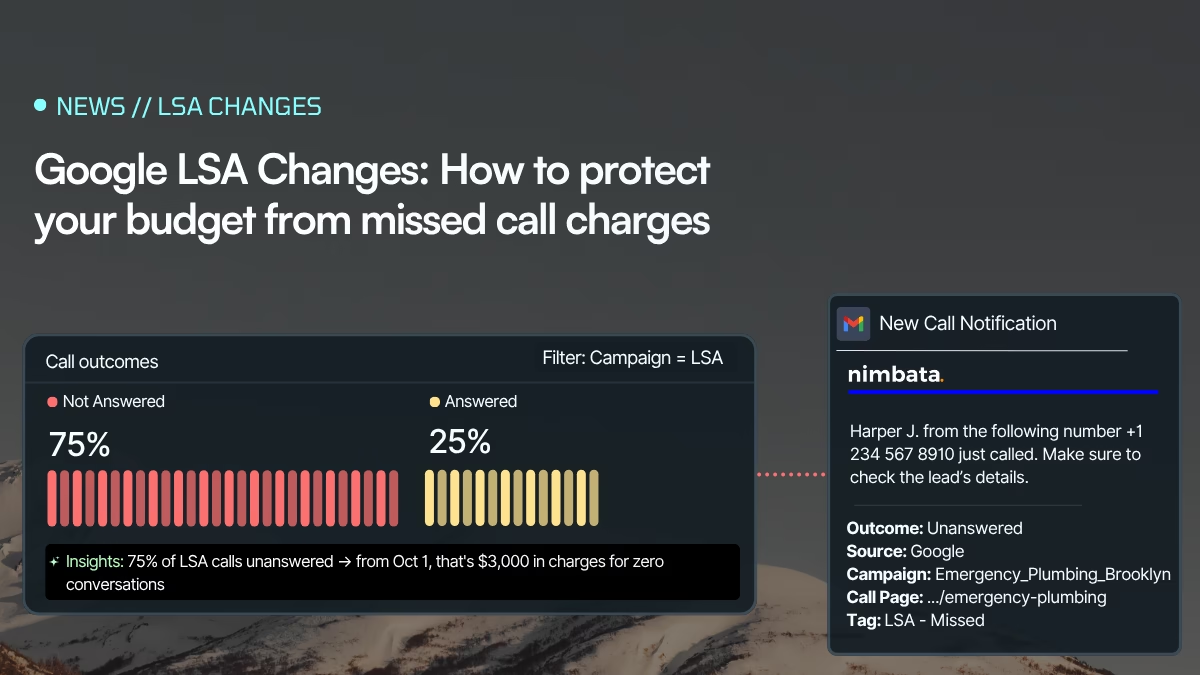
Google is changing how Local Services Ads calls are charged.
Starting October 1, a Local Services Ads call that rings for more than 20 seconds during your stated business hours can become a billable lead, even if nobody at your business answers it.
At the same time, Local Services Ads are moving into Google Ads as a specialized Performance Max campaign type.
Together, these changes make one thing much more important:
Your LSA budget is no longer determined only by your ads. It’s also determined by what happens when the phone rings. How quickly your team answers, when your business is available, how calls are routed and whether you can recover missed calls can now have a direct impact on the real cost of acquiring a customer.
This assumes you’re already running Local Services Ads. If you’re not, our guide to how Local Services Ads work covers the setup and the pay-per-lead model first.
Here’s what’s changing and what you can do to protect your budget.
What is changing with LSA call charges?
From October 1, Google is expanding the situations in which Local Services Ads phone calls can become billable.
A missed LSA call that rings for more than 20 seconds during your stated business hours can qualify as a billable lead, even if nobody at your business answers it.
Google has not specified whether that 20 seconds runs from the first ring or from the moment the call connects to your line. But the 20-second threshold itself, the business-hours requirement and the fact that unanswered calls can become billable are part of the announced change.
That’s a significant expansion of your exposure, but it’s important to be precise about what changed.
Missed calls were not previously always free.
Under Google’s existing lead rules, a missed call with no voicemail could already become a valid lead if your business called the customer back and either spoke with them or left a voicemail.
The difference now is that the exposure is broader. A call can become billable after ringing for more than 20 seconds during business hours, even if your business never has a conversation with the caller.
The math: the same leads can suddenly cost 25% more
This is where the change becomes real.
Imagine your LSA calls cost $40 per lead.
| Before October 1 | After October 1 | |
|---|---|---|
| Received Calls | 100 | 100 |
| Answered Calls | 80 | 80 |
| Missed Calls | 20 | 20 |
| Leads charged | 80 | 100 |
| Total spend | $3,200 | $4,000 |
| Cost per conversation | $40 | $50 |
The verdict? Same phone. Same leads. 25% more spend.
Nothing about your campaign needed to get worse. Your ads can perform exactly the same way. The only difference is that 20 calls rang for more than 20 seconds without anyone picking up.
That makes answer rate a much more important part of your advertising economics.
If that math changes how you feel about the channel, it’s worth revisiting how Local Services Ads compare with standard Google Ads before you move budget anywhere.
And there’s another reason you need to get ahead of this.
You can no longer manually dispute individual leads
In July 2024, Google removed the manual process advertisers previously used to dispute individual Local Services Ads leads.
There is no longer a form you can submit to request a manual review of a specific lead. Instead, Google uses automated systems to determine whether advertisers receive credits for invalid leads.
When a credit is issued, Google says it can be applied to your account balance within 30 days. The original charge can still remain visible on the invoice.
There are also important limitations to the automated credit system. Healthcare and tax specialist advertisers, as well as advertisers in EMEA, are not eligible for automated lead credits.
The practical consequence is straightforward:
You have less control over what happens after you’re charged.
You can’t simply collect your evidence, submit a dispute and ask for an individual manual review. Google determines whether an automated credit is issued.
That changes what your own call data is worth.
Your call records are no longer just useful for reporting. They are your independent record of what actually happened: whether the call was answered, whether anyone called back, what happened during the conversation and whether the call was a genuine opportunity.
If you’re being billed for something you can’t manually dispute lead by lead, you need your own record of what happened.
The operational levers you can control
The charging changes make phone operations part of your LSA strategy. There are several things you can control before and after a call reaches your business.
Your stated business hours are now a budget lever
The new missed-call charging rule applies specifically to calls received during your stated business hours. That means inaccurate or overly generous hours can now create a direct financial cost.
For example:
if your LSA profile says you’re open until 8 PM but your team stops answering calls at 5 PM, you’ve created a three-hour window where paid calls can ring for more than 20 seconds without anyone being available to handle them.
Previously, that was mainly a customer service problem. Now, it can also be an advertising cost problem.
Review your hours and ask:
- Is someone genuinely available to answer during every listed hour?
- Are calls routed somewhere when the primary team is unavailable?
- Are you listing hours based on when the business is technically open, rather than when someone can handle a new lead?
Your advertised availability should reflect your actual ability to respond.
That doesn’t necessarily mean reducing your hours. For some businesses, the better answer will be call forwarding, overflow routing or an answering service. The important thing is that your LSA availability and your phone coverage are aligned.
The 15-day rule: callbacks need to be in your records too
The new rules also affect how follow-up calls are handled. According to Google’s clarification, advertisers are charged once for qualifying follow-up calls made within 15 days of the initial interaction.
That 1x limit matters. Your callbacks don’t create an unlimited series of additional charges during that period.
But they do mean your outbound call activity should be visible alongside the original LSA interaction.
You need to know when the original LSA call happened, whether it was answered or missed, whether your team called back, what happened during the callback and whether the customer became a genuine opportunity.
This is no longer just about tracking incoming calls.
Your complete call journey matters.
The IVR exception: useful, but not a substitute for answering calls
There is one important exception in the announced rules.
If your phone system uses an IVR that requires the caller to press a key, the 20-second timer starts when the caller presses that key.
For example:
“Thanks for calling [Business Name]. Press 1 to speak with our team.”
This means a caller can enter your phone system, hear the greeting and remain connected without starting the 20-second timer. The timer begins only once they press the key.
If they hang up before pressing anything, they don’t cross the 20-second threshold under this rule.
That’s an important distinction.
A key-press IVR doesn’t eliminate missed-call charges. It changes when the 20-second clock begins.
Once the caller presses the key, the timer starts. If they then stay on the line for more than 20 seconds during your business hours without being answered, that call can become billable.
This makes the IVR exception particularly useful because it creates a clearly defined starting point for the timer, unlike the standard call flow where Google hasn’t publicly specified exactly when the 20 seconds begins.
But it should still be treated as a safety net, not the solution.
The trade-off: IVRs create friction
An IVR asks the caller to do something before reaching a person.
For someone researching options, that might be a small inconvenience. For someone dealing with an emergency, it can be much more significant.
Imagine someone whose water heater has just failed. They don’t want to navigate a phone menu. They want someone to answer.
Adding friction can increase abandonment. And responsiveness matters beyond the individual call. If your call experience becomes slower or less effective, that can affect your LSA performance and visibility.
There’s also no guarantee that Google’s current exception will exist forever. Google can change its charging policies.
So the goal shouldn’t be:
How do we stop calls from becoming billable?
The better question is:
How do we make sure every genuine caller gets handled as effectively as possible while protecting ourselves from unnecessary charges?
Fast answering still comes first. The IVR provides an additional layer of protection around that process.
How to keep an IVR simple
If you decide to use one, avoid building a complicated phone tree.
A simple setup might be:
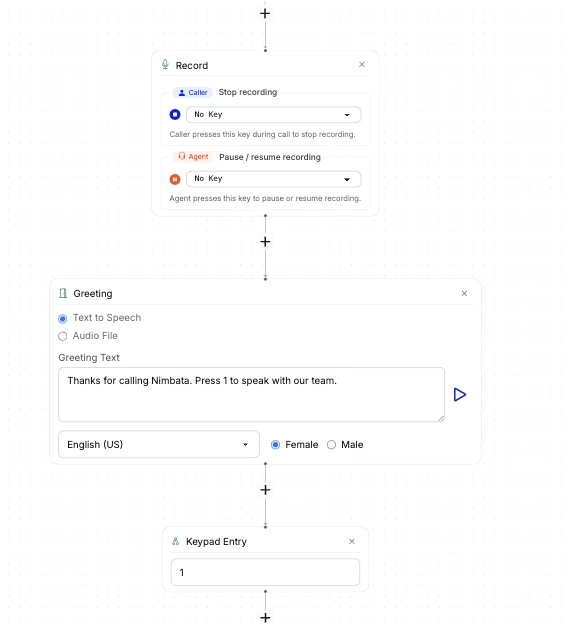
Once the caller presses 1, route them immediately to someone who can answer.
Avoid:
- Long introductions
- Multiple layers of menus
- Unnecessary questions
- Multiple routing options
The more complicated the IVR becomes, the greater the risk of losing genuine callers.
The ideal setup is simple: one quick action, then get the caller to a real person as fast as possible.
The bigger problem: you need to know what happens after the phone rings
The new charging rules make one thing clear: Google’s definition of a lead and your definition of a valuable opportunity aren’t necessarily the same.
A paid call might be answered by your team, missed, called back later, a qualified opportunity, an existing customer, outside your service area, about a service you don’t offer, spam or a caller who never books.
Google can tell you about the lead.
Your business needs to understand the outcome.
That’s where independent call intelligence becomes important.
How Nimbata helps you see the complete picture
The most useful way to think about Nimbata here isn’t as another reporting layer. It’s as the system that connects LSA spend to what actually happened on the phone.
Track the full call journey
You should be able to see:
- Which calls came from LSA
- Whether they were answered or missed
- How long they rang
- When missed calls happened
- Whether your team called back
- What happened during the conversation
- Whether the call was qualified
- Whether it resulted in a booking or customer
The ring-duration data is particularly important under the new rules.
Google has confirmed the 20-second threshold, but hasn’t publicly specified exactly when that clock begins in every call scenario. Your own call records are therefore how you can observe what the threshold looks like in practice across your actual LSA calls.
This is also particularly important under the 15-day follow-up rules. You don’t want your inbound LSA calls in one system and your outbound callbacks somewhere else. You need the complete timeline.
Find the operational leaks
Your overall answer rate doesn’t tell the whole story.
Break your data down by time of day, day of the week, location, team or department and call source.
You might find that your business answers 90% of calls overall. That sounds great. But perhaps your answer rate drops to 55% between 4 PM and 6 PM, exactly when a team is leaving jobs and nobody is covering the phones.
That’s not just a reporting insight anymore. It’s a potential advertising cost.
Once you know where calls are being missed, you can take action:
- Forward calls during busy periods
- Add overflow routing
- Send calls to another location
- Use an answering service
- Adjust staffing
- Trigger immediate missed-call follow-up
Understand which paid calls are actually valuable
A billable call isn’t automatically a good lead.
Nimbata’s call intelligence and AI analysis can help identify what happened during the conversation, so you’re not limited to counting calls.
You can understand which calls were qualified opportunities, relevant service inquiries, bookings, existing customers, irrelevant inquiries or missed opportunities.
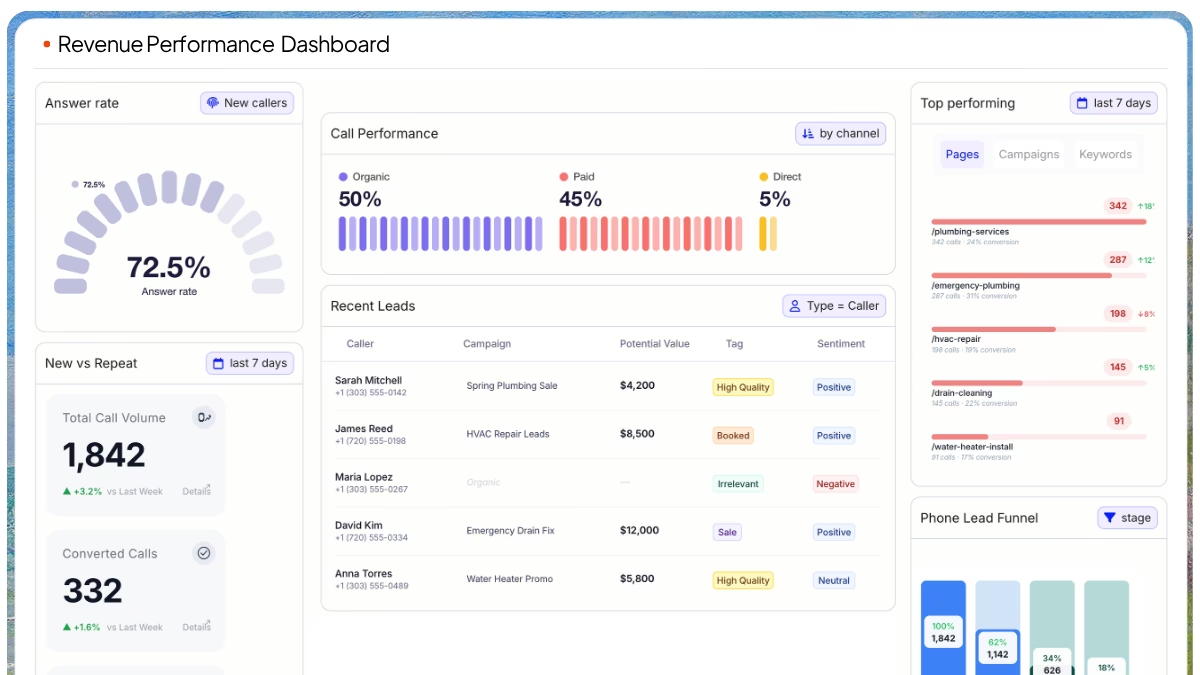
That gives you a more useful metric than Google’s lead count:
What did we actually get for the calls we paid for?
LSA is moving into Google Ads. Download your reporting before migration.
The changes to call charging aren’t happening in isolation.
Google is also moving Local Services Ads into Google Ads as a specialized Performance Max campaign type. The core LSA model remains focused on generating leads through Google Search and Maps, but campaign management and reporting are moving into the broader Google Ads environment.
There’s one practical thing advertisers should do now:
Download your historical LSA reporting before your account migrates.
Google’s migration guidance states that historical performance data does not carry over into the new campaign structure.
If historical LSA performance matters to how you evaluate your campaigns, save the reports you want to keep before the migration happens.
That transition is another reason to maintain your own independent call data.
Platform reporting can change. Definitions can change. Your own call records shouldn’t depend entirely on how Google currently chooses to display LSA performance.
For more on the transition, see Google’s Local Services Ads migration documentation and Search Engine Land’s coverage of the move to Google Ads and Performance Max.
FAQ: What advertisers still need to know
Does the 20-second timer start when the phone first rings?
Google hasn’t publicly specified whether the 20 seconds runs from the first ring or from the moment the call connects to your line.
The 20-second threshold itself is confirmed. The exact technical starting point of that timer has not been clearly defined in Google’s public documentation.
Will missed-call leads cost the same as answered LSA leads?
Google hasn’t publicly stated that every missed-call lead will cost the same as every answered call.
LSA lead pricing can vary based on factors including the business, service category and market.
The $40 example in this article demonstrates how additional billable calls can increase the effective cost of actual conversations.
Can I still dispute an individual LSA charge?
Not through the previous manual dispute process.
Google removed manual individual lead disputes in July 2024 and now uses automated systems to determine eligible lead credits.
That makes independent call records increasingly important for understanding what happened, even when you don’t control the credit decision.
Could Google close the IVR exception?
Yes. Google can change its policies.
The key-press exception is part of Google’s current announced approach. Advertisers shouldn’t build their entire call strategy around the assumption that a specific exception will remain permanently unchanged.
The safest long-term strategy is still to answer genuine callers quickly and build an effective missed-call recovery process.
Know what happened to every call you paid for
The biggest takeaway from Google’s LSA changes isn’t simply that you may pay for more calls.
It’s that the gap between a billable lead and a valuable conversation can become more expensive.
A missed call can now mean:
- A lost customer
- A missed opportunity
- And potentially a charge
And because you have limited ability to manually dispute individual leads, waiting until the charge appears isn’t a strategy.
The businesses best positioned for these changes will know:
- Which calls they’re paying for
- Which calls they’re answering
- Which calls they’re missing
- What happens during callbacks
- Which calls are actually qualified
- And what those calls ultimately produce
Nimbata gives you the call intelligence to see that complete picture.
Because if your advertising platform is charging you for the phone ringing, you should know exactly what happened next.
See what happened to every call you paid for
Track every LSA call, identify missed opportunities, understand call quality and connect your paid calls to real business outcomes with Nimbata.