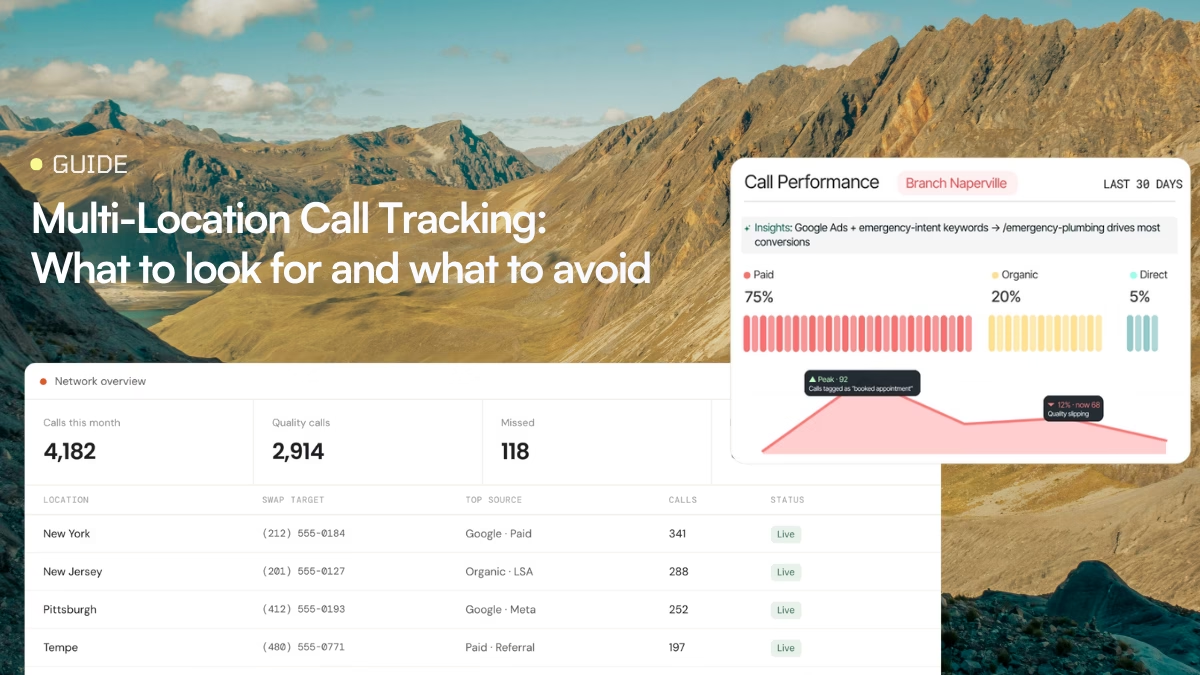
To track calls for multi-location businesses, install one call tracking script across your whole website and give every location its own set of tracking numbers. The script detects which location page a visitor is on and which marketing source sent them, then swaps the displayed phone number accordingly. Callers still reach the right branch, while the platform records the location, channel, campaign, and keyword behind every call.
If you manage marketing for a franchise, a dealership group, a healthcare network, or any business with multiple branches, you have probably asked the same question: which locations are actually generating phone calls, and which marketing channels are driving them?
Learning how to track calls for multi-location businesses is what turns that question into an answer. It is the difference between knowing your network received 4,200 calls last month and knowing that your Dallas branch received 312 calls, that 41% came from Google Ads, and that 18% went unanswered after 5pm.
This guide walks through the entire process: how multi-location call tracking works, how many tracking numbers you need, how to deploy it across every location page without a development project, and what to look for before you commit to a platform.
Key takeaways
- Multi-location call tracking attributes every inbound call to two things at once: the location that received it and the marketing source that generated it.
- The mechanism is number swapping, not call monitoring. The platform detects which location page a visitor is on and swaps the displayed phone number for a tracking number tied to that branch.
- You have two tracking levels. Visitor-level tracking (Dynamic Number Insertion) links calls to individual website sessions. Channel-level tracking links calls to marketing sources. Most networks mix both.
- A rough sizing formula for channel-level tracking: Tracking Numbers = Locations x Marketing Sources.
- One sitewide script beats per-location setup. At 200 locations, per-page implementation becomes unmaintainable and new branches should inherit the configuration automatically.
- Pilot before you scale. Roll out to a representative group of 10 to 20 locations, validate routing and reporting, then expand.
What is multi-location call tracking?
Multi-location call tracking is a system that attributes each incoming phone call to both the specific business location that received it and the marketing source that generated it. Instead of recording one undifferentiated conversion, it captures the branch, the channel, the campaign, and in many setups the individual keyword behind every call.
That dual attribution is the whole point. Standard call tracking answers “which campaign produced this call?” Multi-location call tracking answers “which campaign produced this call, for which branch, and did that branch answer it?”
For a network, it makes questions like these answerable:
- Which branch received the call?
- Did the customer arrive from Google Ads or organic search?
- Did the call originate from a Google Business Profile listing?
- Which campaigns generate qualified phone leads in each market?
- Which locations miss the most calls?
It matters most for organizations running a single website with dedicated location pages:
- Franchise systems
- Dealer and dealership networks
- Healthcare and dental groups
- Home service companies (HVAC, plumbing, roofing, pest control)
- Multi-branch banks, credit unions, and insurance agencies
- Retail chains and fitness studios
Without location-level attribution, every phone lead is just another ringing phone. With it, each call becomes a measurable data point tied to a market, a campaign, and a team.
How is it different from a standard call tracking setup?
Single-location call tracking tells you which marketing campaigns generate phone calls. Multi-location call tracking tells you which campaigns generate phone calls for each individual location, while giving headquarters a consolidated view across the entire network.
The operational differences run deeper than reporting:
| Feature | Single-Location Call Tracking | Multi-Location Call Tracking |
|---|---|---|
| Business structure | One business at one address | Networks of branches, franchises, dealerships, or regional offices |
| Website setup | One site with a single phone number or a few tracking numbers | One site with dozens or hundreds of location pages, each needing its own configuration |
| Call attribution | Identifies the marketing channel | Identifies the marketing channel and the location that received the call |
| Tracking numbers | A small pool shared across campaigns | Dedicated numbers for every location and every measured source |
| Deployment | One-time implementation | One sitewide deployment that automatically covers current and future locations |
| Reporting | One dashboard | A dashboard per location plus a centralized HQ view |
| User permissions | Everyone sees the same reports | Role-based access so each branch sees only its own calls |
| Marketing insights | Campaign performance for one business | Campaign performance compared across locations, regions, and markets |
| Operational insights | Mainly marketing attribution | Surfaces missed calls, misrouted calls, and low answer rates by branch |
| Scalability | Minimal change as the business grows | Built for new locations, ownership changes, and regional expansion |
Why phone calls are harder to track than form submissions
Tracking an online form is straightforward. When someone submits a contact form, the session already carries the marketing context: the campaign they clicked, the keyword they searched, the landing page they arrived on, the traffic source, and the device. All of it travels with the submission automatically.
Phone calls do not work that way.
When someone dials a number, the call itself carries no information about how they found your business. Your phone system sees a caller ID and nothing else. By the time the phone rings, the entire marketing journey has vanished.
That is why GA4, Google Ads, and standard analytics platforms cannot connect phone leads to the campaigns that produced them on their own.
The solution is not to track the call. It is to track the phone number the visitor sees before they dial
How to track calls for multi-location businesses in 7 steps
Here is the full implementation sequence, from planning through ongoing maintenance.
Step 1: Map every location and the marketing sources you want to measure
Before touching any software, build a simple inventory. For each location, list the branch name, the destination phone number that calls should route to, the location page URL, and the marketing channels you want attributed separately.
Most networks land on some combination of Google Ads, organic search, Google Business Profile, Local Services Ads, print or offline campaigns, and referral traffic. This inventory becomes your configuration blueprint and drives the number of tracking numbers you will need.
Step 2: Choose your tracking level (visitor-level or channel-level)
There are two ways to attribute a call, and they answer different questions.
Visitor-level tracking, also called Dynamic Number Insertion (DNI), temporarily assigns every active website visitor a unique tracking number drawn from a pool dedicated to that location. Because each visitor gets their own number, every call links back to the exact session that produced it, including keyword, campaign, landing page, and referrer.
| Location | Visitor | Displayed Number | Captured Data |
|---|---|---|---|
| New York | Visitor A | (212) 555-0184 | Session, campaign, keyword, landing page |
| New York | Visitor B | (212) 555-0187 | Session, campaign, keyword, landing page |
| New York | Visitor C | (212) 555-0192 | Session, campaign, keyword, landing page |
Channel-level tracking assigns one number per marketing source per location. Every Google Ads visitor to the New York page sees the same New York Google Ads number, while visitors to the Dallas page see a different Dallas set.
| Location | Marketing Source | Displayed Number |
|---|---|---|
| New York | Google Ads | (212) 555-0184 |
| New York | Organic Search | (212) 555-0188 |
| New York | Google Business Profile | (212) 555-0193 |
Visitor-level tracking gives you keyword-level call attribution and costs more numbers. Channel-level tracking is cheaper and simpler but stops at the source. High-traffic locations running multiple digital campaigns usually justify DNI. Smaller branches often do not.
Whichever you pick, the caller experience is identical. They dial a local number and reach the correct branch. The attribution happens invisibly.
Step 3: Calculate how many tracking numbers you need
One of the most common misconceptions is that the number of tracking numbers depends on call volume. It does not. It depends on how you configured Step 2.
For channel-level tracking, the math is simple:
Tracking Numbers = Locations x Marketing Sources
If you want to attribute Google Ads, organic search, Google Business Profile, Local Services Ads, print advertising, and referral traffic, that is six numbers per location. Across 40 locations, 240 numbers.
For visitor-level tracking (DNI), numbers are assigned to concurrent website visitors rather than channels. Each location needs a pool large enough that every simultaneous visitor to that location page receives a unique number. Pool size scales with peak concurrent traffic, not with monthly call volume. Higher-traffic location pages need larger pools.
Mix the two. The right platform lets you run DNI on your ten busiest markets and channel-level tracking on the rest, so you are not paying for session-level attribution at branches that will never use it. Model the cost against your projected network size, not today’s footprint. See how call tracking pricing actually works before you commit.
Step 4: Deploy one tracking script across your entire website
This is the step that separates enterprise-ready platforms from everything else.
Some systems require a separate implementation for every location page. That is manageable at five branches. At 200 it is a maintenance problem that never ends, and every new store opening becomes a development ticket.
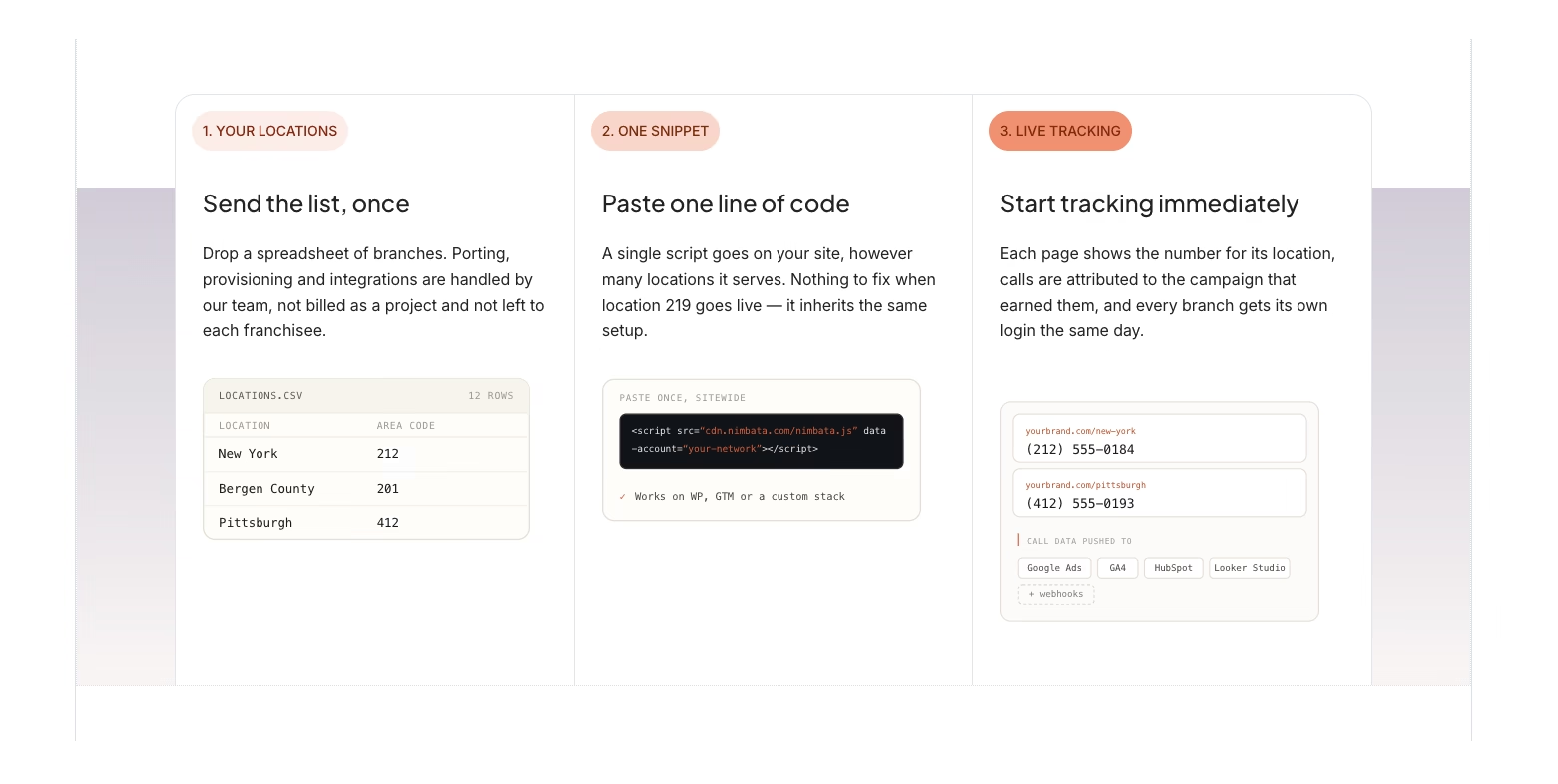
A scalable platform uses one tracking script sitewide. When a visitor lands on any location page, the script automatically identifies which location they are viewing and which marketing source brought them there, then displays the correct tracking number. Someone on your Chicago page only ever sees Chicago numbers. Someone on your Dallas page only ever sees Dallas numbers.
The real advantage is not convenience. It is that new locations inherit the existing setup with no new implementation, no new script, and no new configuration round. For a growing franchise system, that difference is worth hundreds of hours over the life of the platform.
Step 5: Set up location-level dashboards and permissions
Data nobody can access is not useful. Before launch, configure:
- An individual dashboard for every location, showing that branch’s calls, recordings, sources, and answer rates
- A unified network dashboard for headquarters, with location-versus-location comparison
- Role-based permissions so a branch manager sees only their own calls and HQ sees everything
- Regional or franchise-owner groupings, so a multi-unit owner can view their own set of branches together
Treat locations as independent projects rather than tags inside one shared account. Reporting, permissions, and ownership changes (which happen constantly in franchising) become far easier to manage that way.
Step 6: Connect calls to Google Ads, GA4, and your CRM
Call data trapped inside a call tracking dashboard is a silo. Push it into the systems where budget decisions actually get made.
At minimum, wire up:
- Google Ads, so calls import as conversions and Smart Bidding can optimize toward them
- GA4, so phone leads sit alongside form fills in the same conversion reporting
- Your CRM (HubSpot, Salesforce, or similar), so calls attach to contact records and can be traced to closed revenue
Nimbata connects to these platforms and more, and there are specific guides for HubSpot call tracking and setting up call conversions correctly.
Step 7: Pilot, test, and audit before scaling network-wide
Do not flip the switch on 200 locations at once. Structure the rollout:
- Start with a pilot group of 10 to 20 locations that represent different markets, sizes, and operating models.
- Establish a baseline. Avoid changing ad campaigns during the first few weeks so reporting reflects the implementation rather than marketing shifts.
- Place a test call to every tracking number before launch to confirm routing and reporting.
- Train local teams. Branch managers should understand why a different number appears on their page, how reporting works, and what they can access.
- Schedule monthly audits verifying that every location is tracking, numbers route correctly, attribution is intact, and integrations are still connected.
A short monthly review catches problems before they contaminate a quarter of reporting.
What good multi-location call tracking looks like
The goal is not collecting more data. It is making that data usable by everyone in the organization.
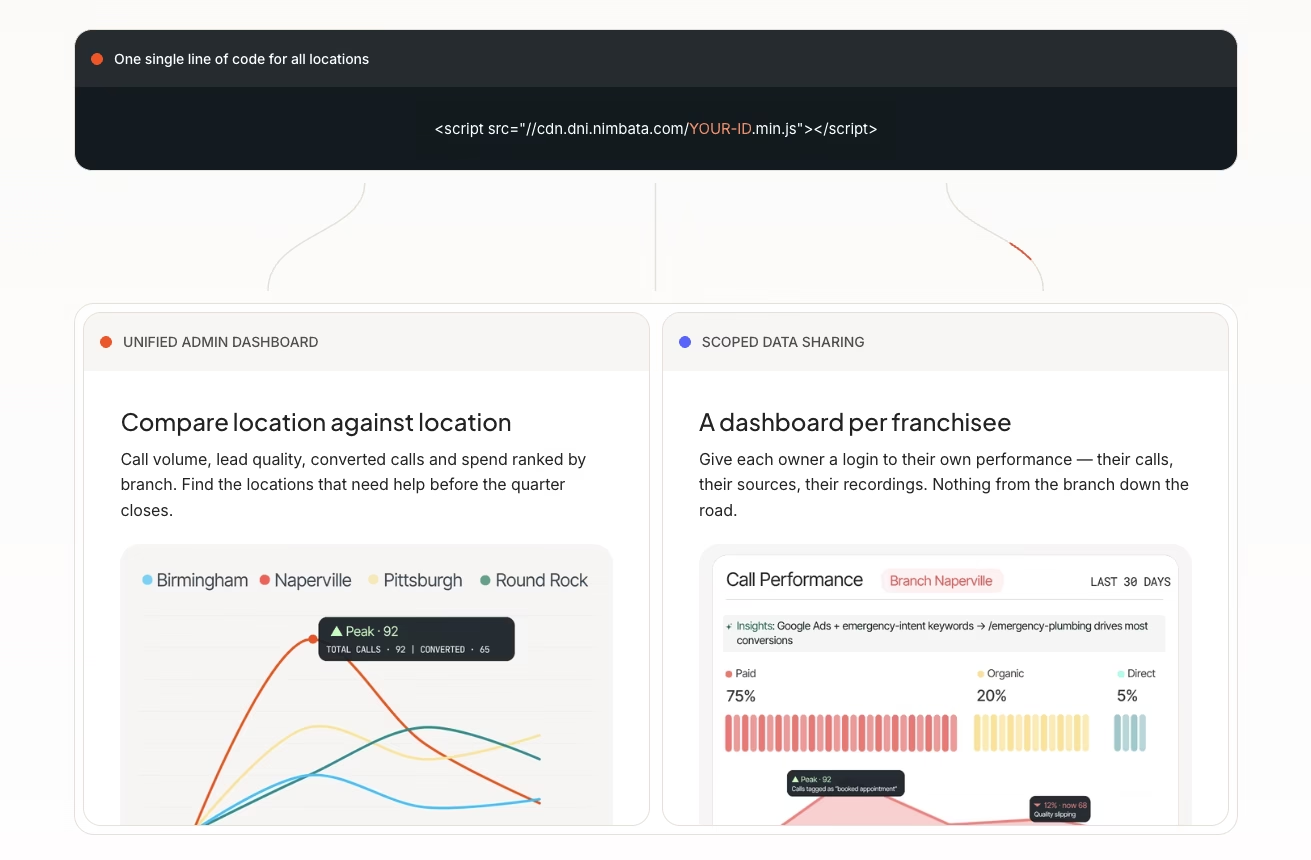
A well-designed deployment delivers:
- Individual dashboards for every location
- A unified dashboard for headquarters
- Role-based permissions scoped to each branch
- Location-versus-location performance comparisons
- Complete visibility into every phone interaction across the network
That creates a single source of truth for marketing, operations, franchise owners, and executives. Instead of debating which locations are succeeding, everyone works from the same numbers.
What to look for in a multi-location call tracking platform
Many call tracking products were built for single-location businesses and later stretched to serve enterprise customers. The seams show as you scale. When you evaluate vendors, weight these five areas heavily.
1. One deployment across your entire website
The platform should need a single implementation, not one per location page. New locations should inherit the configuration automatically.
2. Location-level permissions
Each branch manager should access only their own calls, recordings, and reports. Headquarters keeps full network visibility.
3. Flexible account structure
Locations should exist as independent projects rather than tags inside a single shared account. This makes reporting, permissions, and ownership transfers dramatically easier.
4. Easy onboarding
Adding branches should not require custom development. Look for bulk onboarding, standardized deployment templates or done-for-you setup offerings.
5. Complete marketing attribution
Integrations with Google Ads, GA4, and your CRM should be native, so calls become part of your broader reporting instead of isolated data points. If you are in a regulated industry, confirm the platform supports HIPAA-compliant call tracking.
A quick vendor comparison for franchises & multi-location businesses
Here is how the platforms most often shortlisted by location networks compare at a glance. Positioning and starting prices come from our full hands-on review of the best call tracking software, where we tested 11 tools.
| Platform | Starting price | Best fit for a location network |
|---|---|---|
| Nimbata | $39/mo | Franchises, dealer groups, and agencies that want one sitewide script, per-branch workspaces, and predictable per-number pricing |
| CallRail | $55/mo | Smaller networks and individual franchisees who want accessible call intelligence without enterprise tooling |
| CallTrackingMetrics | $79/mo | Networks that also need contact center features such as outbound dialing, SMS, and IVR routing |
| Convirza | $29/mo | High-volume networks that need thousands of calls scored automatically each month |
| Invoca | Custom | Fortune 1000 brands with enterprise budgets and mature conversation intelligence requirements |
| Marchex | Custom | Mid-market and enterprise auto, healthcare, and home services networks focused on customer experience |
| WhatConverts | $30/mo | Teams that want calls, forms, and chats in a single lead view across every location |
Prices are the published entry tier and will not reflect what a 50-location or 200-location deployment actually costs. Run every shortlisted vendor against the five criteria above, then model the price at your projected network size.
For the full feature-by-feature breakdown see the best call tracking software comparison, or if CallRail is your incumbent, the top CallRail alternatives.
6 common mistakes multi-location businesses make
Implementing call tracking across a large network is not just about installing software. It is about building a system that keeps working as the business grows. Most organizations do not hit problems until months after deployment, when reporting drifts, locations quietly stop tracking, or franchisees lose trust in the data.
1. Rolling out to every location at once
A network-wide launch feels fastest, but it carries the most risk. One configuration error replicates across hundreds of locations before anyone notices. Pilot first.
2. Only tracking paid advertising
Plenty of businesses implement call tracking exclusively for Google Ads. That leaves large attribution gaps, because customers also find you through organic search, Google Business Profile, Local Services Ads, referral sites, and offline campaigns.
Worse, it distorts the picture: if paid is the only tracked source, paid will appear to generate a disproportionate share of calls simply because nothing else is measured. Give every major acquisition channel its own attribution, including organic search and Google Business Profile listings.
3. Choosing a platform on price alone
Call tracking pricing looks simple and rarely is. One vendor advertises a low per-number rate, another a low platform fee. Real cost depends on the number of tracking numbers required, call volume, the pricing model (per minute versus per answered call), user seats, AI and conversation intelligence features, and integrations.
Always model cost at your future network size. A platform that looks cheap during a 20-location pilot can become expensive at 250.
4. Ignoring phone number ownership
Phone numbers are business assets. They end up on vehicle wraps, storefronts, brochures, business cards, Google Business Profiles, and local directories. Before signing, get clear answers on who owns the tracking numbers, whether existing numbers can be ported in, and whether they can be ported out if you switch providers. Without that clarity, changing vendors or agencies later becomes far harder than expected.
5. Measuring call volume instead of lead quality
Not every call is a sales opportunity. Networks receive calls from existing customers, job applicants, suppliers, wrong numbers, and support inquiries. Optimizing on raw call counts produces misleading conclusions.
Define what counts as a qualified conversation and measure against that. A lead qualification framework and the right call metrics and KPIs matter more than volume. AI call scoring and transcription can automate most of this classification.
6. Treating call tracking as a marketing tool only
One of the biggest surprises for new adopters: call tracking often exposes operational problems before marketing ones. You may discover that certain locations regularly miss calls, that calls route to the wrong branch, that after-hours calls go unanswered, or that some locations respond dramatically faster than others.
Those findings improve customer experience, staffing, and efficiency. The most successful deployments involve both marketing and operations from day one.
Questions to ask before you choose a vendor
Switching call tracking platforms gets harder as your network grows, so evaluate scalability early. These questions reveal more than any feature list:
- Does the entire website require one tracking script or multiple implementations?
- How are new locations added, and how long does it take?
- Can each location have its own dashboard and scoped permissions?
- Can existing phone numbers be ported in?
- Who owns the numbers contractually?
- Can locations be grouped by region or franchise owner?
- Does the platform integrate natively with Google Ads, GA4, and our CRM?
- Is pricing per minute or per answered call?
- Can we export all of our data if we decide to migrate?
Multi-location call tracking should scale with your business
As organizations expand, marketing decentralizes. New locations open. Ownership changes hands. Ad budgets vary by market. New campaigns launch monthly. Your call tracking platform should absorb that complexity rather than add to it.
The right setup makes these questions answerable on demand:
- Which locations generate the most qualified phone leads?
- Which marketing channels drive those leads, market by market?
- Which branches miss the most opportunities?
- Where should marketing budget increase, and where should it be cut?
- Which locations need operational support rather than more advertising?
Instead of stitching together data from multiple systems, decision-makers get one accurate view of performance across the entire organization.
Frequently asked questions
The platform detects which location page a website visitor is viewing, then dynamically replaces the displayed phone number with a tracking number assigned to that branch. When the visitor calls, the system records which location and which marketing source produced the call, then forwards the caller to the branch’s real phone line. The caller notices nothing different.
For channel-level tracking, multiply your number of locations by the number of marketing sources you want measured separately. Six sources across 40 locations equals 240 numbers. For visitor-level tracking with Dynamic Number Insertion, each location needs a pool sized to its peak concurrent website traffic rather than its call volume.
No, as long as your real business number stays as the primary listed number in your Google Business Profile and citations, and the tracking number is added as a secondary number. Google explicitly supports this. Use dynamic number insertion for website display so crawlers and directories continue to see your canonical number.
In most cases yes. Established local numbers printed on signage, vehicles, and directories can usually be ported into a call tracking platform. Confirm porting terms, timelines, and portability out before signing, since number ownership varies significantly by vendor.
Dynamic Number Insertion assigns a unique number to each active website visitor, linking calls to individual sessions and keywords. Channel-level tracking assigns one number per marketing source, linking calls to a channel like Google Ads or organic search. DNI is more granular and uses more numbers; channel-level tracking is simpler and cheaper.
A pilot of 10 to 20 locations typically takes one to two weeks including testing. Full network rollout depends mostly on number provisioning and porting timelines rather than technical setup, since a sitewide script requires no per-location development. Most networks complete a full deployment in four to eight weeks.