Local Services Ads vs. Google Ads is a common question for local businesses deciding where to invest their advertising budget. Both can help you reach potential customers through Google, but they work in very different ways.
The right choice depends on your business, your audience, your service area, and what you want to get from your campaigns. Do you need phone leads from people ready to hire? More control over keywords and targeting? Or a combination of both?
Although both are Google advertising products, Local Services Ads and Google Ads have different targeting options, placements, pricing models, and levels of control. Let’s look at the main differences and where each option fits best.
Local Services Ads: Focused Ads for Service Businesses
If you run a plumbing business, law firm, HVAC company, or another local service business, most of your customers are likely to come from a specific geographic area.
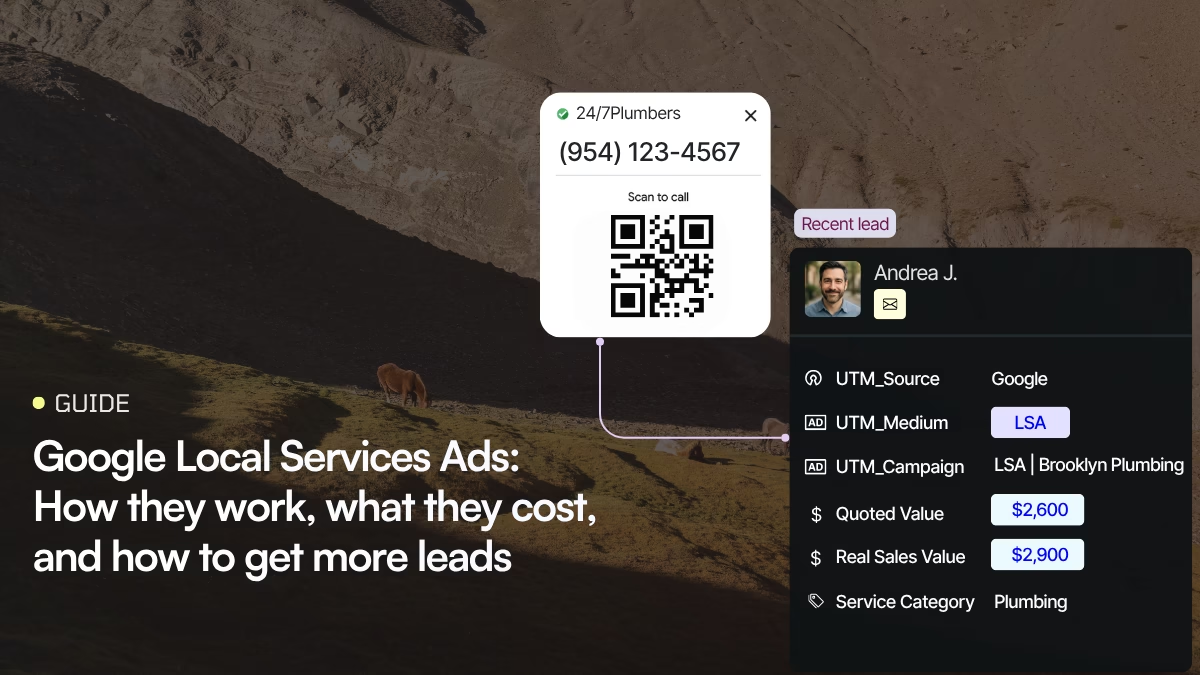
Local Services Ads are designed specifically for eligible service businesses that want to connect with customers in the areas they serve. Instead of relying primarily on website clicks, Local Services Ads are built around generating leads directly through calls and messages.
They can include important information such as:
- Business name and service
- Service area
- Customer reviews
- Business hours
- Photos
- Contact options
Local Services Ads can be particularly useful for businesses where customers typically search with immediate intent, such as “plumber near me,” “emergency electrician,” or “personal injury lawyer.”
🔥 If you want to learn more about Local Service Ads check out 👉 Local Service Ads & How to Grow With Them
Local Service Ads vs Google Ads: The big showdown
Alright, now it’s the time you’ve been waiting for! The big rumble in the jungle. Let’s take a closer look at Google Ads vs Local Service Ads, see their differences, and how each can benefit your business.
| Local Services Ads | Google Ads | |
|---|---|---|
| Best for | Local service businesses | Local and broader businesses |
| Primary goal | Generate leads | Generate clicks, leads, sales, and other actions |
| Targeting | Service area and eligible services | Keywords, audiences, locations, etc. |
| Pricing | Primarily lead-based | Primarily click-based |
| Keyword control | Limited | High |
| Ad placement | Dedicated Local Services placement | Search and other Google properties, depending on campaign |
| Campaign control | Simpler | More granular |
| Scalability | More limited | Highly scalable |
| Best suited for | High-intent local searches | Businesses needing greater campaign control |
Audience & reach
Google Ads gives you a high degree of control over where your ads can appear and who you can target. Depending on the campaign type and settings, you can target specific cities, regions, radius areas, or much larger geographic markets.
That flexibility makes Google Ads useful for both local businesses and companies with broader markets. You can build campaigns around specific locations, search intent, audiences, and business goals.
Local Services Ads are much more focused on the geographic areas your business serves. You define your service areas and the services you provide, and Google matches your business with relevant local searches.
For a local service business, this can be a major advantage. Someone searching for an electrician nearby is much more likely to become a customer than someone searching from an area you cannot serve.
The key difference: Google Ads gives you more control over reach, while Local Services Ads are designed around connecting local service businesses with customers in their service areas.
Placement
Google Ads can appear prominently in Google Search results when they are relevant to a user’s query. Their position depends on factors such as your bid, ad quality, relevance, competition, and other auction signals.

Local Services Ads have a dedicated placement designed specifically for local service searches. They can appear prominently in Search and provide users with key information about the business before they make contact.

One important difference is how much information users can see at a glance. Local Services Ads can display details such as reviews, business information, services, and contact options, making it easier for someone to compare local providers.
Reviews can be especially important here. When several businesses appear together, a strong rating and a solid review profile can help your business stand out.
Budgeting
Google Ads generally follows a pay-per-click (PPC) model. You set a budget and pay when someone clicks on your ad. That click can lead to a website visit, a phone call, a form submission, or another conversion.
Local Services Ads use a pay-per-lead model. Instead of paying for every click, you pay for valid leads generated through the Local Services platform.
This creates an important difference in how you think about campaign performance.
With Google Ads, you need to look beyond clicks and measure what those clicks actually produce. A campaign can generate plenty of traffic without generating enough qualified leads.
With Local Services Ads, the focus is already closer to the final action because the platform is designed around lead generation.
The fact that you pay per lead does not automatically make Local Services Ads cheaper. What matters is the cost and quality of the leads you generate and how many of them turn into customers.
Lead Cost & Management
In Google Ads, you pay for clicks whether or not the visitor eventually becomes a lead. That means your cost can accumulate quickly if your targeting is too broad, your keywords are not well matched to your services, or your landing page does not convert.
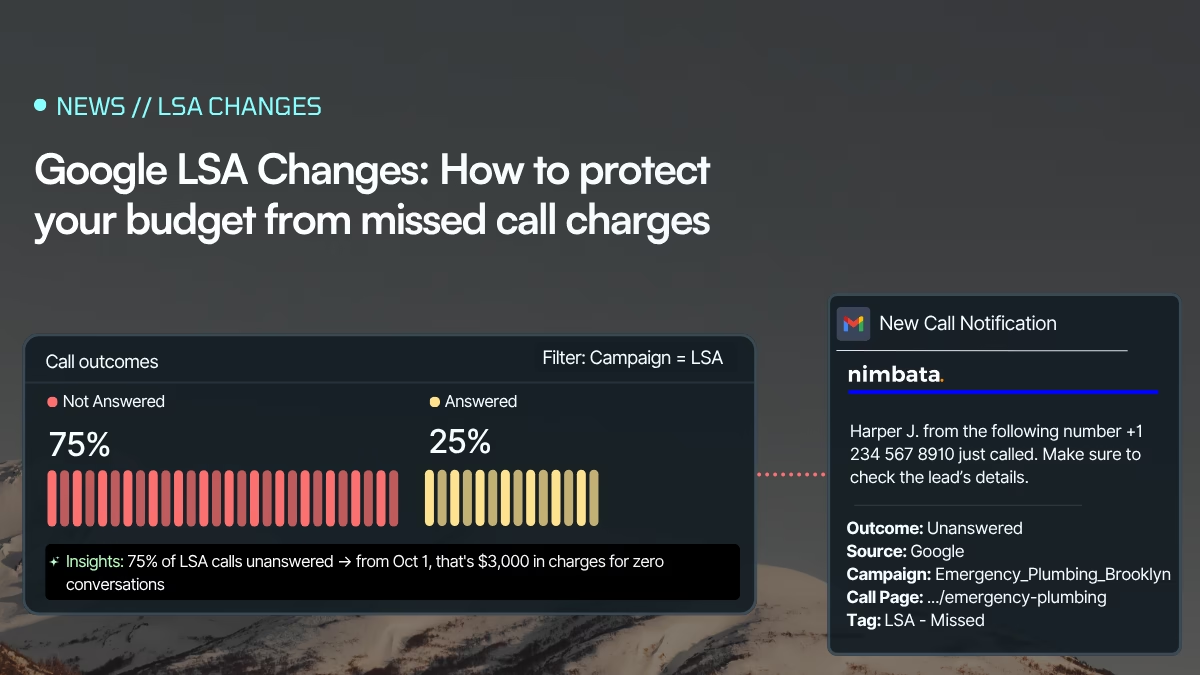
Local Services Ads work differently. You are charged for eligible leads rather than every click. Leads can come through phone calls or messages, depending on the setup and market. Note that Google has changed how missed calls are charged, and you can track Local Services Ads messages in Nimbata alongside the calls.
However, paying per lead does not mean every lead is automatically valuable. You still need to consider factors such as:
- Is the caller looking for a service you actually provide?
- Are they located in your service area?
- Are they a new or existing customer?
- Did the conversation result in a qualified opportunity?
- Did the lead eventually become a booked job or customer?
This is where lead quality becomes more important than lead volume.
The cost per lead can be significantly higher than the cost per click in Google Ads, but that comparison alone does not tell you which channel is more profitable. A $10 click that never turns into a customer is less valuable than a $50 lead that becomes a $1,000 job.
Setting Up & Running
Google Ads gives you a lot of flexibility, but that flexibility also means there is more to manage.
You need to make decisions around campaign structure, keywords, targeting, bidding, ad messaging, landing pages, negative keywords, conversion tracking, and ongoing optimization.
Local Services Ads are generally simpler to set up and manage. You select your business category, services, service areas, budget, and other business information, while Google handles much of the matching between searches and your business.
That makes Local Services Ads easier to manage for business owners who don’t want to spend a significant amount of time inside an advertising platform.
The tradeoff is control. Google Ads requires more work, but gives you more levers to optimize performance. Local Services Ads simplify the process, but give you fewer campaign-level controls.
Keywords
Keywords are one of the biggest differences between Google Ads and Local Services Ads.
With Google Ads, you choose the keywords you want to target. You can research search demand, organize keywords into campaigns and ad groups, use different match types, add negative keywords, and optimize based on performance.
This gives you much more control over the searches that can trigger your ads.
With Local Services Ads, Google handles much of the matching based on your business category, services, service areas, and other information. You don’t manage a traditional keyword list in the same way you do with Search campaigns.
The advantage is simplicity. You spend less time researching and managing keywords.
The disadvantage is less control over exactly which searches generate visibility. If your business serves a very specific niche, you may have less ability to fine-tune your targeting around highly specific long-tail searches.
So, if keyword-level control is important to your strategy, Google Ads has the clear advantage.

Google Verified Badge
Trust is an important factor when customers are choosing a local service provider. Local Services Ads can display a Google Verified badge for eligible businesses that have completed Google’s required screening and verification process.
The verification process varies by business category and location and can include checks such as business registration, licenses, insurance, background checks, and other verification requirements.
The badge can help businesses stand out in Local Services Ads by giving potential customers an additional trust signal when comparing providers.
Google Ads does not use the same Local Services-specific verification badge. Instead, businesses can build credibility through their website, Google Business Profile, reviews, ad messaging, and other information available to potential customers.
For local service businesses, this is one of the differences that makes Local Services Ads distinct from standard Google Search campaigns.
Scalability
Local Services Ads and Google Ads can both generate leads, but they offer very different levels of control when you want to grow.
Google Ads gives you significantly more flexibility. You can expand into new locations, add keywords, test different messages, create new campaigns, adjust bids and budgets, and target different audiences.
This makes Google Ads easier to scale strategically as your business grows.
Local Services Ads are more focused. You can adjust your services, service areas, budget, and other available settings, but you don’t have the same level of keyword and campaign control you get with Google Ads.
That doesn’t make Local Services Ads a weaker option. It simply means they are built for a different job.
Local Services Ads are particularly useful for capturing local, high-intent demand. Google Ads is better suited to businesses that need more control, testing, and room to scale.
Call Tracking in Google Ads & Local Services Ads
We’ve looked at the differences between Google Ads and Local Services Ads. Now let’s look at one thing they have in common: both can generate valuable phone leads.
For many local businesses, a phone call is not just another conversion. It can be the first step toward a booked appointment, completed job, new client, or sale.
That makes it important to know not just how many calls you generate, but where those calls came from and what happened after the phone rang.
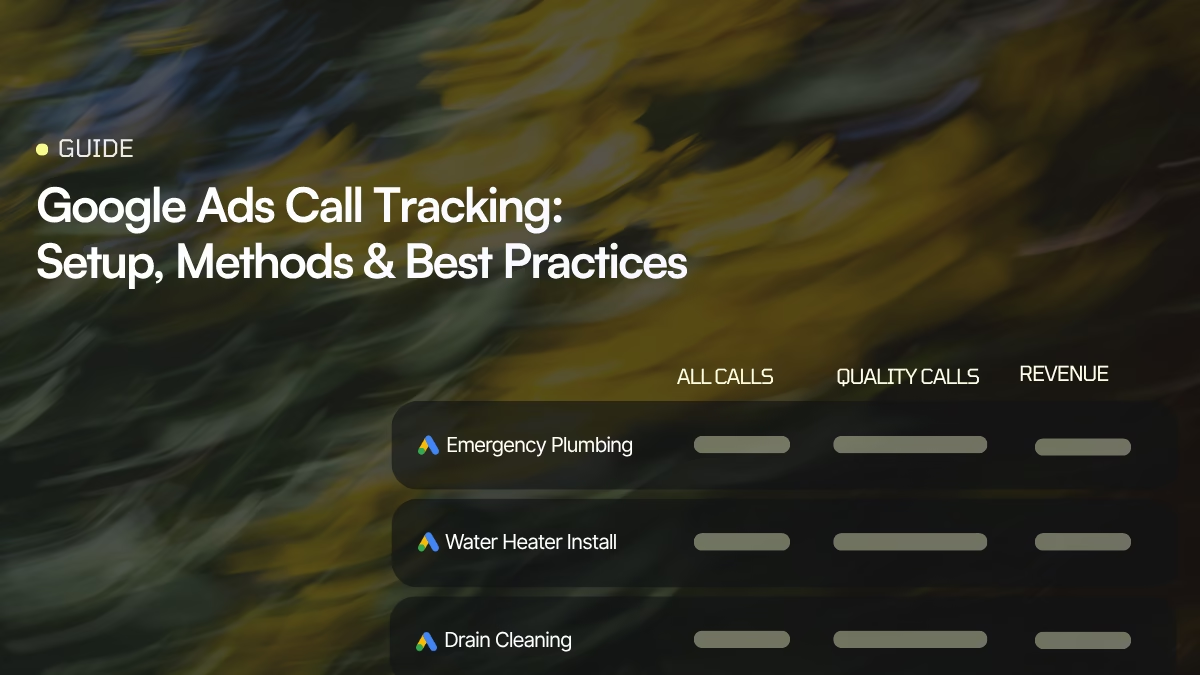
Google Ads can measure calls from ads on its own, but that only counts them. Call tracking ties each call back to the campaign, keyword, or ad that produced it, and our guide to Google Ads call tracking covers the full setup.
Nimbata Call Tracking
Nimbata helps businesses track, analyze, and act on the calls generated by their marketing campaigns.
Instead of looking at call volume alone, you can use call data to understand what happened during each conversation and what should happen next.
With Nimbata, you can:
- Track and attribute calls back to their marketing source
- Record and transcribe calls to understand what happened in each conversation
- Automatically classify and tag calls based on the information that matters to your business
- Use AI to generate call summaries and surface key conversation insights
- Analyze lead quality, outcomes, and buying intent without manually listening to every recording
- Route and manage calls with custom call flows, greetings, whispers, surveys, and voicemail
- Automate follow-up actions based on call data and outcomes
- Send call insights to your CRM and other marketing tools so your team can act on them
This gives marketers a clearer picture of how Google Ads, Local Services Ads, and other marketing channels contribute to actual business results.
Setting it up is straightforward: connect your account with the Google Ads integration, add the dynamic number insertion script to your site, then send call conversions back to Google Ads. You can test the whole flow on a free trial and see which channel is actually booking the work.
Frequently Asked Questions about local services ads vs google ads
Not necessarily. Local Services Ads can be a strong option for local service businesses that want to generate calls and other leads from high-intent local searches. Google Ads offers more control over keywords, targeting, ad messaging, and campaign structure. The better option depends on your business and goals.
The main difference is how they work. Local Services Ads are designed specifically for eligible local service businesses and use a pay-per-lead model. Google Ads gives businesses more control over targeting, keywords, bidding, and ad formats, with Search campaigns generally operating on a pay-per-click model.
No. Local Services Ads have their own placement in Google Search and can also appear across Google’s local surfaces. Google Ads Search campaigns appear as paid search ads within the standard search results. The exact placement can vary depending on the campaign and Google’s ad formats.
There is no universal answer. Local Services Ads charge for leads, while Google Ads Search campaigns generally charge for clicks. The more useful metric is the cost of a qualified lead or customer, rather than comparing cost per click with cost per lead.
Yes. Using both can help a business capture demand in different ways. Local Services Ads can focus on high-intent local service searches, while Google Ads can provide greater control over keywords, targeting, messaging, and campaign expansion.
Call tracking can help you understand what happens after a call is generated, especially when you need to measure lead quality, call outcomes, and customer acquisition. For businesses that rely heavily on phone leads, connecting call data with marketing and CRM data can provide a clearer view of campaign performance.
Yes. Businesses can use call tracking to capture and analyze calls generated by their marketing. The level of attribution and available data can differ between channels, so it’s important to use a tracking setup that gives you the information you need to evaluate call quality and campaign performance.
For a small local service business, Local Services Ads can be a simple way to generate local leads without managing a complex Search campaign. Google Ads may be the better choice if the business needs more control over keywords, targeting, ad messaging, or campaign growth. In many cases, testing both can help determine which channel produces better-quality customers.
The bottom line
Google Ads and Local Services Ads can both be effective for local businesses, but they are designed with different levels of control and different approaches to lead generation.
If your priority is capturing high-intent local demand, Local Services Ads can be a strong option. They are built around local service searches, provide prominent visibility, and use a pay-per-lead model.
If you need more control over keywords, targeting, ad messaging, campaign structure, and scalability, Google Ads gives you more flexibility.
For many local businesses, the best strategy isn’t necessarily choosing one over the other. Running both can allow you to capture demand through Local Services Ads while using Google Ads to reach additional searches and build a more flexible acquisition strategy.
Whichever channels you use, don’t stop at measuring clicks or call volume. Track the calls, understand their quality, and connect them to the campaigns that generated them. That’s how you can make better decisions about where to put your next advertising dollar.